How to build speed without making mistakes
Build speed by repeating a short passage cleanly at a tempo you can manage, then raising the tempo in small steps only when it feels easy. Stop at the first sign of mistakes or tension and go back a step. Speed comes from accurate, relaxed repetitions spread over several days, not from forcing the tempo in one session.
When students try to get faster by simply going faster, the same things happen: notes get skipped, the rhythm smears and hands tense up. Every messy repetition is still a repetition, so the mistakes get practised along with the notes.
The fix feels backwards at first. To get faster, slow down, get it right, and let the speed grow out of accuracy.
I often see this in lessons when a student arrives frustrated with a fast passage.
Start with a short passage
Speed work goes best in small pieces. Take two to four bars, or a single run, rather than the whole piece. Short passages let you repeat many times without getting tired, and you can hear clearly what is going wrong.
- Mark the exact start and end of the passage, and include the first note of the next bar so the join is practised too.
- Find the hardest spot inside the passage and practise just those few notes first.
- When the short passage is secure, link it with the bars on either side.
Keep the beat in mind while you work. Count out loud at the start and know where the strong beats fall, so that when the tempo rises you still feel the shape of the bar rather than a blur of notes.
This is the idea behind deliberate practice, summarised in Wikipedia’s article on practice as a learning method (opens in a new tab): break a skill into small parts and keep the challenge a little above what feels comfortable.
Raise the tempo in small steps
Set a start tempo where the passage is clean and relaxed, then climb in steps of a few BPM. A good rule is three clean repetitions before each step up.
How to know when to speed up
- You can perform the passage three times in a row with no mistakes.
- Your hands, shoulders and jaw stay relaxed.
- You could keep going for another repetition without strain.
When to slow down
If you make two mistakes at the same step, drop back a step. If you make mistakes at two steps in a row, finish at the last clean tempo and come back tomorrow.
Slowing down is not a step backwards. Returning to a tempo you can manage resets the habit you are building, and the next attempt at the higher tempo is usually cleaner.
Plateaus are part of the process
Some days the tempo will not move at all. That is not failure; it is your hands catching up. Stay at the last clean tempo for a session or two, and the next step usually comes on its own after a break.
Letting DrillTime handle the steps
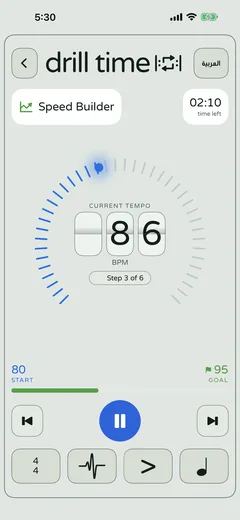
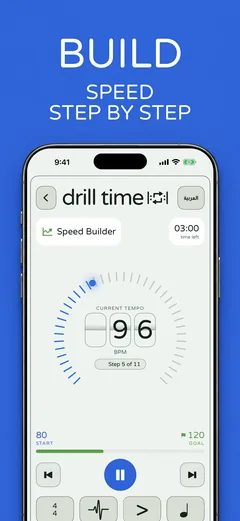
Speed Builder was made for exactly this. You set a start tempo and a goal tempo, and it raises the tempo gradually, showing the current tempo, which step you are on and the time left. For slow, careful work at a single tempo, the metronome does the job.
A sample five-day plan
| Day | Tempo range | Focus |
|---|---|---|
| Day 1 | 70 to 80 BPM | Right notes and rhythm, completely relaxed |
| Day 2 | 76 to 88 BPM | Three clean repetitions at every step |
| Day 3 | 84 to 96 BPM | Notice where tension appears, and slow down there |
| Day 4 | 88 to 96 BPM | A short session to consolidate, nothing new |
| Day 5 | 92 to 108 BPM | Climb steadily, and stop at the first messy repetition |
Few passages reach full tempo in a week, and that is normal. Keep the routine going and your top tempo will keep creeping up.
If you have a lesson coming up, tell your teacher which tempo you reached and where the passage starts to break down. That gives them something precise to work on with you.
Spread the work across the week rather than saving it for one long session. Your hands consolidate between sessions, so five short days of practice usually take you further than one long evening.
Stay relaxed as you speed up
Tension is the hidden speed limit. A tight grip, raised shoulders or a held breath all slow your fingers down, even when you are trying to go faster.
- Check your shoulders and breathing between repetitions.
- Use the smallest movements that still give you a good sound.
- Practise the fast passage softly at first, because loud and fast is harder to keep relaxed.
Rhythm variations can help as well. Practise a run of even notes in a long-short pattern, then short-long, and the even version often feels easier and faster afterwards.
Students are often surprised how much faster they move once they let go of tension.
Key terms
- Clean repetition
- One complete pass through a passage at a set tempo, with the right notes, the right rhythm and no tension.
- Plateau
- A stretch of practice where your top tempo stops rising for a while.
- Deliberate practice
- Focused practice on the hardest parts of a skill, just beyond what feels comfortable.
Questions
How fast can I expect to improve?
It varies with the passage and how often you practise. Small, steady gains over several days are normal; a big jump in one session usually brings mistakes with it.
Should I practise fast passages at full tempo sometimes?
Try it once at the end of a session to see where you are, then go back to a clean tempo. Most of your repetitions should be at a speed you can manage without mistakes.
What if I keep making the same mistake?
Slow down until it disappears, then practise just the few notes around it. A repeated mistake is usually a sign that the tempo is too high for that spot.
Practise with DrillTime
 Coming soon on theقريباً علىApp Store
One-time purchase. No subscription, no ads, no accounts.