How to practise with a metronome
Set the metronome to a tempo where you can perform the passage without mistakes, practise it until it feels easy, then raise the tempo by a small step and repeat. Keep the click on for slow, careful work and turn it off now and then to check that the pulse has become your own. Short, regular sessions with a metronome do more than long, occasional ones.
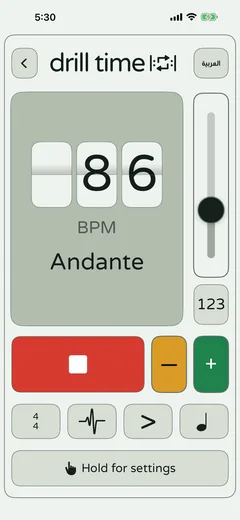
Most students think their timing is fine until they hear it next to a steady click. Then they notice the rush in the easy bars and the drag in the hard ones. A metronome does not judge; it simply holds the beat still so you can hear what your hands are doing.
It also gives practice a shape. Instead of “go through the piece a few times”, you can say “this passage, clean, at 72 BPM”, which is a goal you can actually reach and check.
It does not mean the metronome has to be on all the time. Think of it as a tool that shows you what needs work, then step away from it once the pulse is secure.
In my own lessons, this is often the moment a student first hears their own rushing.
Choosing your starting tempo
The right starting tempo is slower than you want it to be. Find the speed where you can perform the passage three times in a row with no mistakes and no tension. That is your starting tempo for today, even if it is half the marked tempo.
Do not worry if the starting tempo feels painfully slow. Slow, clean practice builds a solid base, and the tempo usually rises faster than you expect once everything is in place.
- If the music has a metronome marking, start new material at roughly half to two thirds of it.
- If you stumble on the first try, drop the tempo before you try again, rather than waiting for the third mistake.
- For pieces you already know, start a little below where you finished last time. The first minutes of a session are rarely your best.
A step-by-step method
- Choose a short passage: two to four bars, or one line of a scale or exercise.
- Set your starting tempo and count one bar out loud before you begin.
- Perform the passage with the click. Aim to land each note exactly on it, so the click almost disappears under your sound.
- When you get it right three times in a row, raise the tempo by a small step, around 4 BPM.
- If you make a mistake, go back one step. If you make mistakes at two steps in a row, stop for the day at the last clean tempo.
- Finish with one run-through without the click, to check the pulse holds on its own.
It helps to write down the last clean tempo at the end of each session. Next time you can start there, or a little below, instead of starting from scratch.
Exam boards teach the same slow-then-gradual approach. ABRSM’s practice advice for students (opens in a new tab) suggests getting the rhythm right at a slow tempo, then gradually increasing the metronome until you reach the correct tempo.
How long should a session be?
For most students, ten to twenty minutes of focused metronome work is plenty, inside a longer practice session. Beginners and young children do better with five to ten minutes. The quality of your attention matters more than the clock.
If you are preparing for an exam or a concert, spend part of each session on the passages where you stumble, rather than starting the whole piece from the top every time.
Practising with the DrillTime metronome
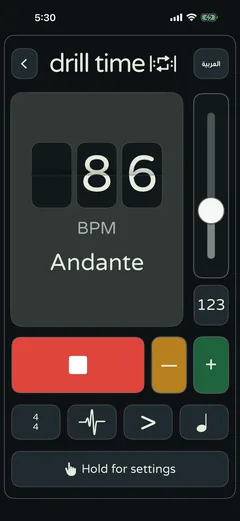
You can do all of this with any metronome. I built the DrillTime metronome with these habits in mind: you set the tempo with a slider or the plus and minus buttons, choose the time signature, accents and click sound, and turn on a count-in so you get a bar to prepare. When you want the app to raise the tempo for you, Speed Builder climbs from a start tempo to a goal tempo in small steps.
A tempo ladder for one week
| Day | Metronome setting | What to aim for |
|---|---|---|
| Monday | 60 to 68 BPM | Right notes and rhythm, relaxed hands |
| Tuesday | 64 to 72 BPM | Three clean repetitions at each step |
| Wednesday | 68 to 76 BPM | An even sound, not just the right notes |
| Thursday | Stay at 72 BPM | Consolidate, with no new speed today |
| Friday | 72 to 84 BPM | Small steps, backing off at the first mistake |
| Saturday | 80 to 88 BPM | The passage inside the whole section |
| Sunday | Rest, or one slow run-through | Let it settle |
The numbers are an example, not a rule. Some weeks you will climb faster, some weeks not at all. What matters is that every step is clean.
You can use the same ladder for scales and technical exercises, not just for pieces.
Common mistakes and how to fix them
- Starting too fast. If the first attempt is messy, the tempo is too high, so slow down straight away.
- Chasing the click. If you wait to hear the click before you move, you will always be slightly late. Feel the beat coming and arrive with it.
- Raising the tempo after one good try. One clean repetition can be luck; three in a row is a habit.
- Never turning it off. The goal is a steady pulse of your own, so switch the click off for the last run-through.
- Using a sound you cannot hear. Choose a click sound that cuts through your instrument. On a loud instrument, a sharper sound helps.
If you keep making the same mistake, go back to the tempo where it disappears and practise just the few notes around it before you run the whole passage again.
This is the mistake I correct most often in lessons.
Key terms
- Metronome
- A device or app that sounds a steady click at a tempo you choose.
- BPM
- Beats per minute, the number that sets the metronome’s speed.
- Count-in
- A bar of clicks before you start, so you can feel the tempo before the first note.
Questions
How much should I increase the metronome each time?
Small steps work best, around 4 BPM at a time. Bigger jumps make it more likely that mistakes creep in and become habits.
Should I always practise with a metronome?
No. Use it for slow, careful work and for checking your timing, then turn it off for part of each session so you can shape the music and keep a steady pulse on your own.
What if I cannot keep up with the click at all?
Slow the tempo right down, even to 40 or 50 BPM, and count out loud. If it is still hard, practise the rhythm away from the instrument first by clapping or tapping it.
Practise with DrillTime
 Coming soon on theقريباً علىApp Store
One-time purchase. No subscription, no ads, no accounts.