How to help your child practise every day
Help your child practise every day by making it short, regular and predictable: the same time each day, one clear small goal, and ten to twenty minutes rather than an hour. Sit nearby, notice effort rather than perfection, and end on something they can do well. A steady daily habit matters far more than long sessions now and then.
As a teacher, I can tell within a minute of a lesson whether a student has practised. The ones who improve fastest are rarely the most talented. They are the ones who pick up their instrument on most days, even briefly.
Parents make a big difference here, and you do not need to read music to help.
I see the difference regular practice makes in my students every week.
How long should children practise?
Less than most parents expect. Short, frequent sessions beat long, rare ones, because skills stick better when practice is spread out. Psychologists call this the spacing effect (opens in a new tab): learning lasts longer when it is spread over several sessions rather than crammed into one.
| Age | Daily practice | Good session length |
|---|---|---|
| 5 to 7 | 5 to 10 minutes | One short session, or two very short ones |
| 8 to 10 | 10 to 20 minutes | One session with a clear goal |
| 11 to 13 | 20 to 30 minutes | One or two sessions |
| 14 and over | 30 minutes or more | Split into focused blocks |
Ask your child’s teacher what fits their stage and their instrument. A focused ten minutes is worth more than half an hour of watching the clock.
Younger children often manage two very short sessions better than one longer one, for example five minutes before school and five after. That still counts as daily practice.
Make practice a daily habit
- Pick the same time every day, such as straight after school or before dinner.
- Keep the instrument out and ready, not packed away in its case.
- Agree one small goal for each session, like two clean repetitions of a tricky bar.
- Use a simple chart or calendar to mark the days they practise.
Habits grow from routine, not willpower. When practice happens at the same time each day, children stop arguing about whether to do it.
Children also like to see their progress. A sticker on the calendar for each day they practise, or a note of the tempo they reached on a hard passage, turns small gains into something they can show you.
When your child does not want to practise
Every child has days like this. Make the session shorter rather than skipping it, so the habit survives. Five minutes of something they enjoy is better than an argument and nothing.
If the resistance lasts for weeks, talk to their teacher. The music may be too hard or too easy, or your child may need a new goal to aim for.
Sometimes a small audience helps. A short performance for a grandparent, or for the family after dinner, gives practice a purpose beyond the next lesson.
What to say, and what to avoid
Your words shape how your child feels about practice.
Helpful things to say
- “I could hear that bar getting smoother.”
- “Show me the part you worked on today.”
- “What was the hardest bit? How did you fix it?”
Things to avoid
Avoid comparing your child with brothers, sisters or classmates, and avoid praising only the result. Comments like “You’re so talented” can make children afraid of mistakes. Notice the effort and the method instead.
It also helps to ask questions rather than give instructions. “What will you work on today?” gives your child ownership of the session, and children stick far more readily with plans they helped to make.
A simple structure for each session
- Warm up for a minute or two with something easy.
- Work on one small goal from the teacher’s notes.
- Practise one tricky spot slowly, then a little faster.
- Finish with a piece they enjoy and can perform well.
Ending on a success matters, because it makes them more likely to come back tomorrow.
If your child’s teacher writes notes in a practice book, read them together at the start of the week, so you both know what the small goals are.
In my experience, this simple order works for most young students.
How DrillTime can help
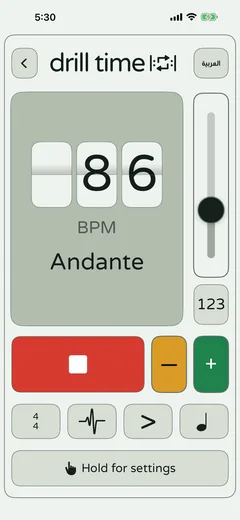
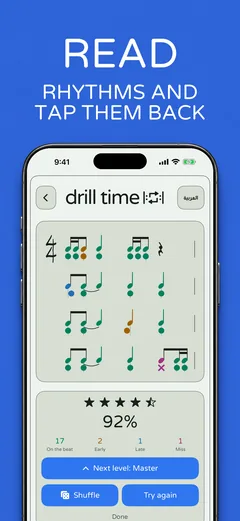
DrillTime works offline, needs no account and collects no personal data, so it is safe to leave on a family iPad. The metronome keeps slow practice steady, Speed Builder raises the tempo in small steps, and Rhythm Shuffler gives your child a fresh rhythm to read and tap, then shows how accurate their timing was.
Key terms
- Practice routine
- A regular time and order for practice, repeated on most days.
- Spaced practice
- Spreading practice over many short sessions instead of a few long ones.
- Small goal
- One specific, achievable target for a single session, such as a clean bar or a steady tempo.
Questions
Should I sit with my child while they practise?
For younger children, yes, or at least stay nearby. Older children often prefer to practise alone, but still enjoy showing you what they have worked on.
Is it better to practise for an hour once a week or for ten minutes every day?
Ten minutes every day. Short, regular practice builds skills and habits far more reliably than one long session.
What if I do not read music myself?
You do not need to. Your job is the routine and the encouragement, and the teacher handles the music. Asking your child to show you what they practised is enough.
Practise with DrillTime
 Coming soon on theقريباً علىApp Store
One-time purchase. No subscription, no ads, no accounts.